
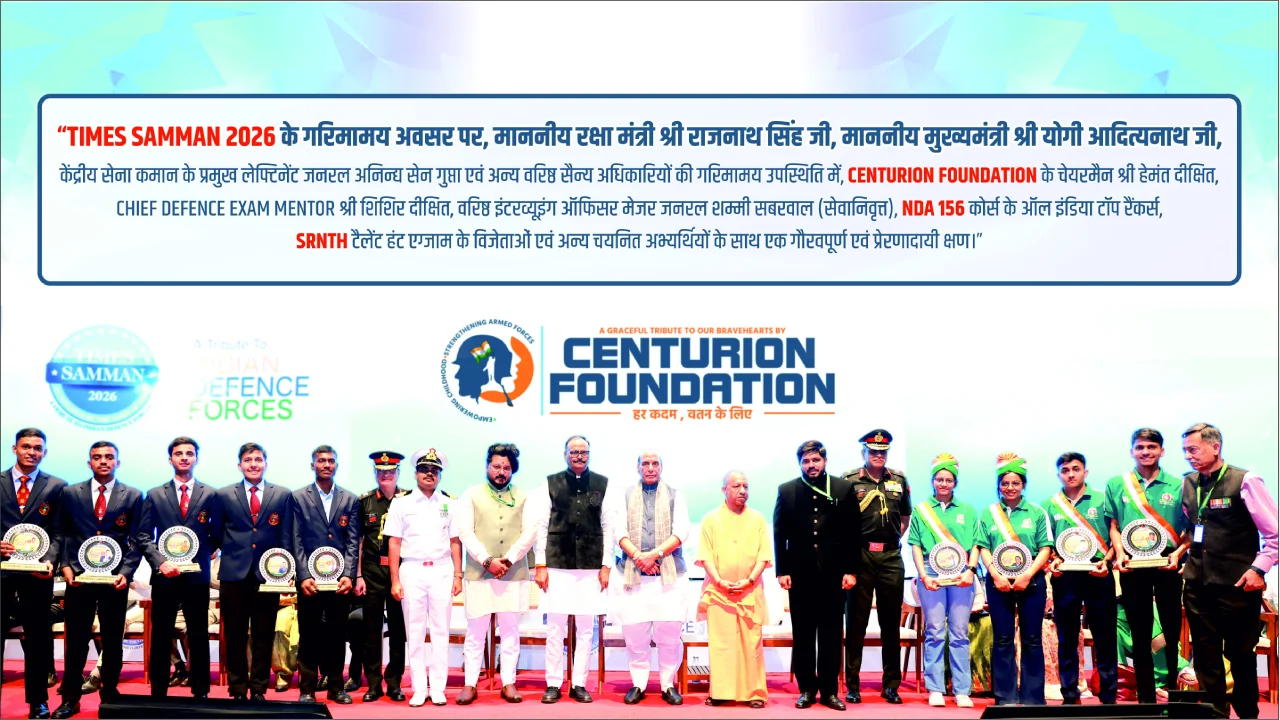
Times Samman Samaroh 2026: A Tribute to Soldiers, Sacrifice, and Silent Strength
Some Debts Could Never Be Repaid. But They Were Never Forgotten.
A tribute to the soldiers who gave everything, the families who carried on, and the Foundation that ensured neither was ever left behind.
Chief Guests: Shri Rajnath Singh, Hon. Defence Minister of India · Shri Yogi Adityanath, Hon. Chief Minister, Uttar Pradesh
Think about the last time you slept soundly at night: no fear, no anxiety, just peace. Then ask yourself: who made that possible?
Somewhere along the borders of this country, in the freezing passes of Siachen, in the dense jungles of the Northeast, in the burning deserts of Rajasthan, a soldier had stood watch so the nation could sleep. And in many cases, that soldier never came home.
What we owed them was beyond calculation. What we owed their families was beyond words. The Times Samman Samaroh 2026 was not just an event. It was India’s way of saying: we remembered. We always did 
Why That Night Mattered More Than Most
We lived in an age of short attention spans. News cycles moved fast. Battles that once defined generations were reduced to footnotes. The names of heroes who stood between this nation and catastrophe slowly faded from everyday conversation.
The Times Samman Samaroh 2026, presented by the Centurion Foundation in association with Times Now, stood on one conviction: those who gave everything for this nation must never be forgotten.
And on that evening, the nation didn’t just remember, it paused, reflected, and honoured.
The Evening as It Unfolded
The ceremony was not just emotional; it was precise, dignified, and deeply symbolic in its execution.
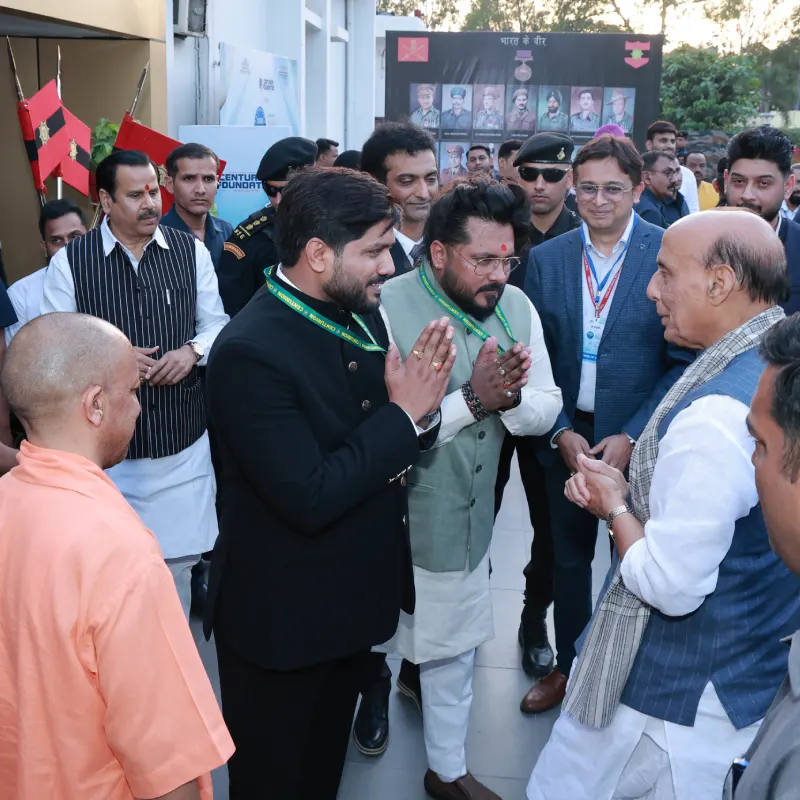
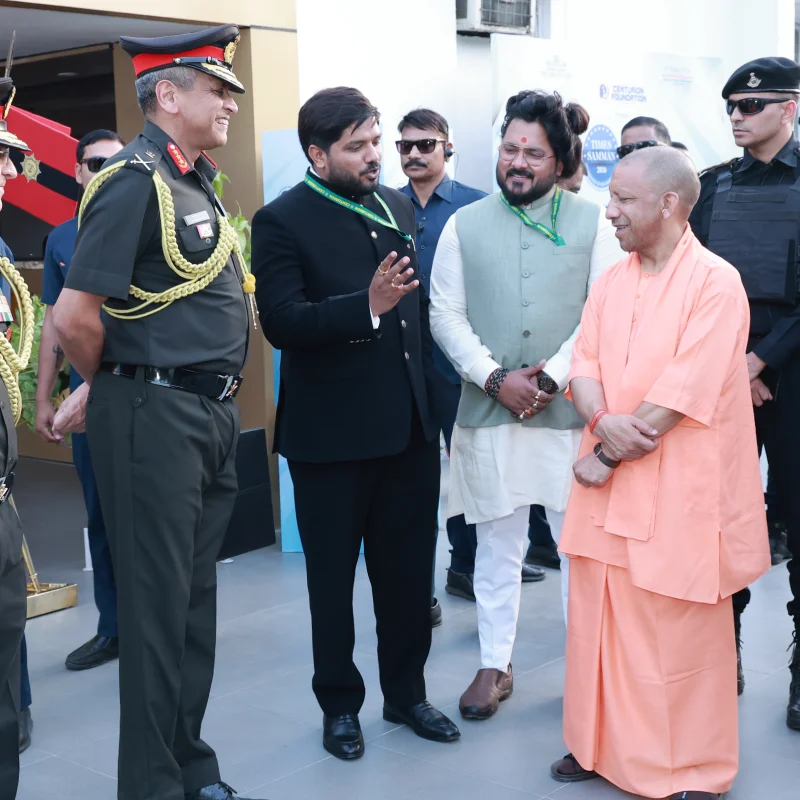
At 5:45 PM, the Hon’ble Defence Minister Shri Rajnath Singh arrived and was received by Shri Yogi Adityanath, along with senior dignitaries, including Mr. Ajay Iyer (Sr. Vice President, TOI), the Army Commander, and Hemant & Shishir Dixit of the Centurion Foundation.
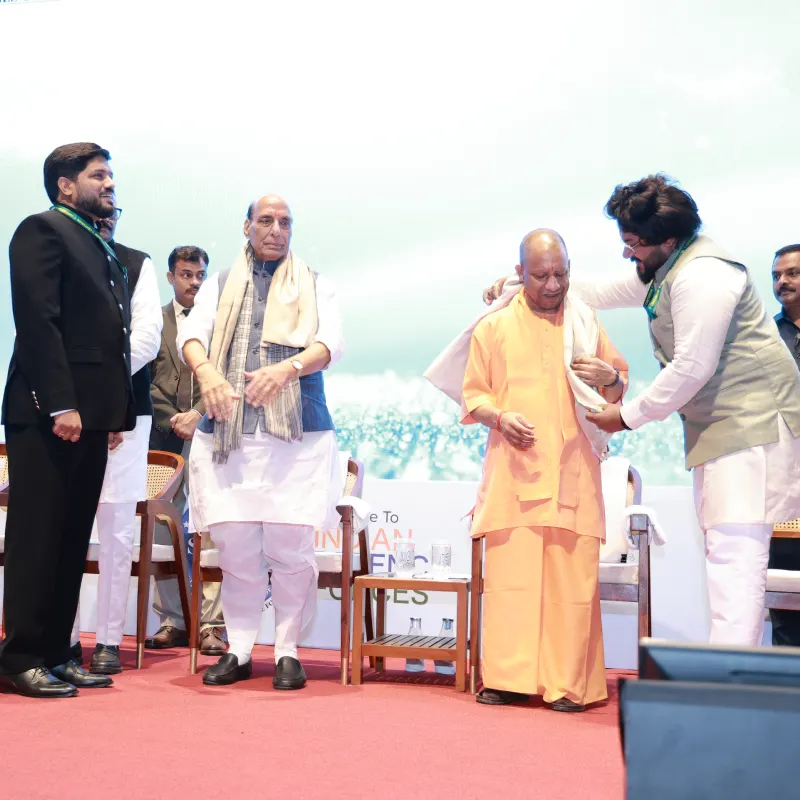
Just two minutes later, at 5:47 PM, the evening formally began with the Lamp Lighting Ceremony, a moment that symbolised remembrance, respect, and the eternal flame of sacrifice. Dignitaries, including the Defence Minister, Chief Minister, Army leadership, and key contributors, came together on stage to mark the beginning.
By 5:52 PM, the stage was set, and the Chief Guests took their seats as the audience settled into an atmosphere of reverence.
At 5:53 PM, Mr. Ajay Iyer delivered the Keynote Address, setting the tone for the evening, one of gratitude, memory, and national pride.
Soon after, at 5:55 PM, Shri Yogi Adityanath addressed the gathering, speaking not just as a Chief Minister, but as a voice representing the collective respect of an entire state.
Honouring Courage — Awards and Recognition
At 6:05 PM, the most powerful segment of the evening began the Awards Conferment Ceremony.
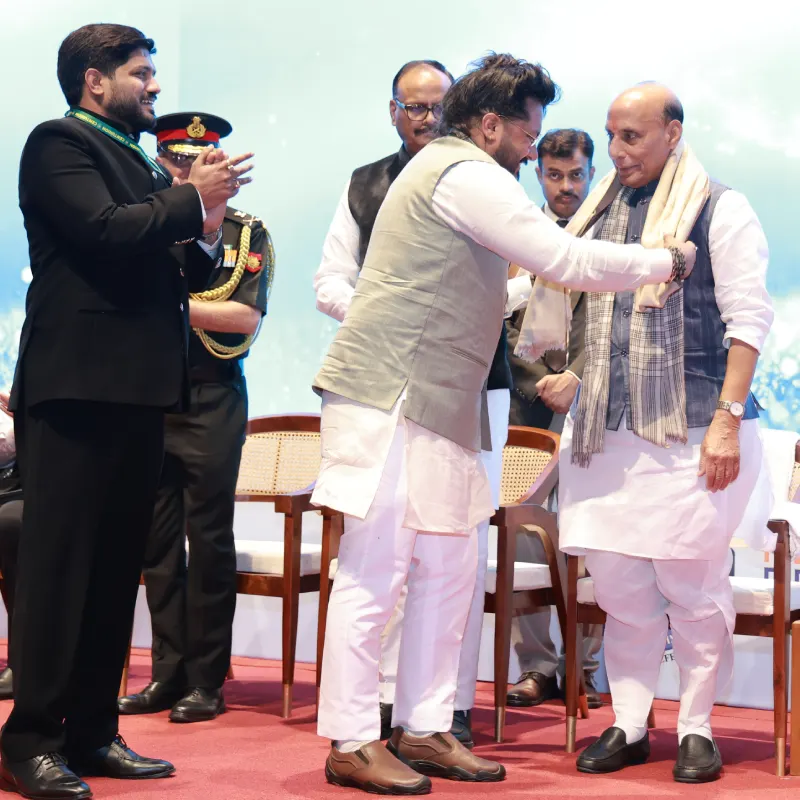
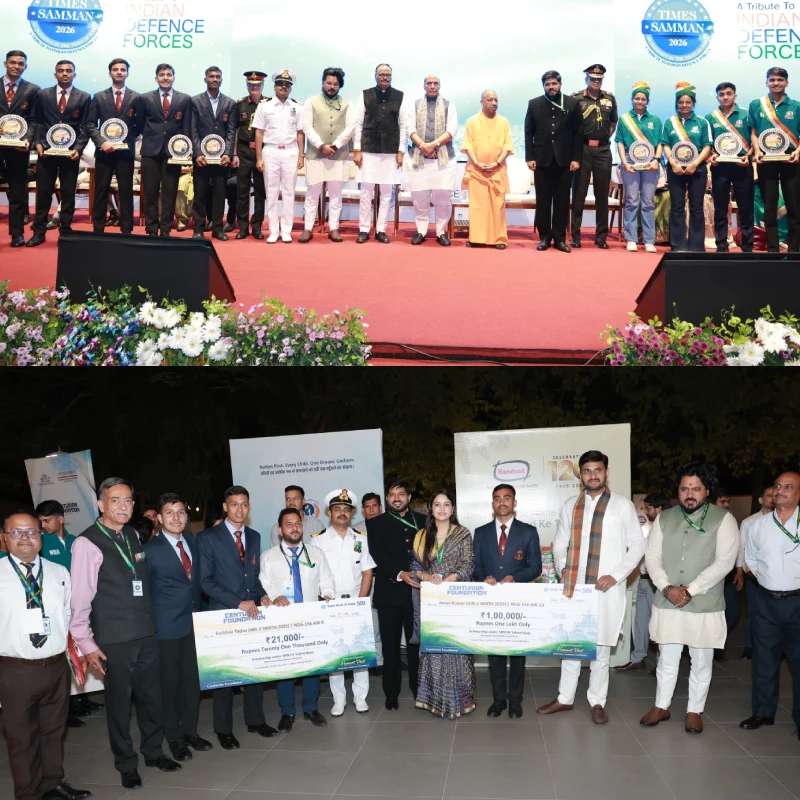
The Hon’ble Defence Minister, Chief Minister, and Army Commander took the stage to honour gallantry awardees and their families. One by one, recipients walked up not just to receive awards, but to receive the nation’s acknowledgement.
These were not mere presentations. Each name carried history. Each step carried sacrifice.
The Centurion Moment
At 6:20 PM, the spotlight turned to the force behind the movement, the Centurion Foundation.
As the anchor introduced the organisation, Hemant Dixit and Shishir Dixit were invited on stage. A powerful audio-visual presentation played across the LED screen, capturing years of struggle, transformation, and impact.
In a symbolic gesture, the Foundation presented ODOP (One District One Product) mementoes to the Hon’ble Defence Minister and Chief Minister representing grassroots India, the very foundation from which the organisation had risen.
Moments later, at 6:22 PM, SSB-selected cadets joined the stage. That image of young aspirants standing beside national leadership and war heroes captured the entire purpose of the evening: legacy being passed forward.
Address by the Defence Minister
At 6:23 PM, Shri Rajnath Singh addressed the audience.
His words carried weight not just as a leader, but as someone deeply connected to the armed forces. His address acknowledged the sacrifices of soldiers, the strength of their families, and the importance of institutions like the Centurion Foundation.
Beyond the Stage — Conversations That Mattered
By 6:33 PM, the ceremony transitioned into a more personal space.
The Defence Minister joined dignitaries and partners for tea at the auditorium lounge. What followed were not formalities, but conversations and interactions that bridged leadership, contributors, and the larger mission.
Event partners presented ODOP mementoes, while TOI honoured key dignitaries with tokens of appreciation.
At 6:40 PM, the Defence Minister spent time in discussion with the Army Commander, a quiet but significant moment reflecting mutual respect and shared responsibility.
A Walk Through Legacy
At 6:45 PM, the Defence Minister stepped out to visit the exhibition stalls, interacting, observing, and acknowledging efforts on the ground.
He then proceeded to the Smritika War Memorial, adjacent to the Surya Auditorium.
That walk from the ceremony to the memorial felt symbolic.
From recognition… to remembrance.
The Highest Honour — Param Vir Chakra Families
The Param Vir Chakra is India's most sacred military honour. It is awarded not for routine bravery but for acts so extraordinary, so beyond human limits, that they defy comprehension.
Every single man who has received this honour did so at the cost of everything. And most of them never came home to hold it in their hands.
At Times Samman 2026, the families of these immortal heroes will be present not as footnotes, but as the centrepiece of the evening. Because if the soldier gave his life, his family gave their world. And it is time they stood in the light that has always belonged to them.
PARAM VIR CHAKRA — FAMILIES BEING HONOURED
|
PVC Awardee |
Rank & Regiment |
Conflict / Operation |
Representation |
|
Piru Singh |
Company Havildar Major, Rajputana Rifles |
Indo-Pak War 1947–48 |
Shri Om Prakash & Ravindra |
|
Karam Singh |
Lance Naik, Sikh Regiment |
Indo-Pak War 1947–48 |
Mr Succhi Singh & Gurpreet Kaur |
|
Gurbachan Singh Salaria |
Captain, 1 Gorkha Rifles |
Congo Crisis 1961 |
Mr Raheshwar Singh |
|
Dhan Singh Thapa |
Major, 8 Gorkha Rifles |
Sino-Indian War 1962 |
Madhulika & Poornima Thapa |
|
Shaitan Singh |
Major, Kumaon Regiment |
Rezang La, 1962 |
Mr Narpal Singh & Riddhiraj Singh |
|
Abdul Hamid |
CQMH, The Grenadiers |
Battle of Asal Uttar, 1965 |
Mr Jamil Hamid |
|
Nirmal Jit Singh Sekhon |
Flying Officer, IAF No. 18 Squadron |
Indo-Pak War 1971 |
Mr Amardeep Singh Sekhon |
|
Arun Khetarpal |
2nd Lieutenant, Poona Horse |
Battle of Basantar, 1971 |
Brig Muken Khetrapal |
|
Hoshiar Singh Dahiya |
Major, The Grenadiers |
Battle of Basantar, 1971 |
Not Specified |
|
Manoj Kumar Pandey |
Lieutenant, 11 Gorkha Rifles |
Kargil War, 1999 |
Shri Manmohan Pandey |
|
Yogendra Singh Yadav |
Grenadier, The Grenadiers |
Kargil War, 1999 |
Attending in person |
|
Vikram Batra |
Captain, J&K Rifles |
Kargil War, 1999 |
Shri Girdhari Lal Batra |
Look at that list. Every name was a universe of sacrifice. Piru Singh had charged enemy positions at Tithwal so his battalion could live. Abdul Hamid had climbed onto his jeep-mounted recoilless rifle, alone, taking on Pakistani Patton tanks and not stopping even as the shells found him.
Vikram Batra, just twenty-four years old, had shouted “Yeh Dil Maange More” on the peaks of Kargil and then had gone back up one more time for a fellow soldier, knowing he might not return. He didn’t. His father, Shri Girdhari Lal Batra, was there that night, carrying his son's legend in his eyes.
Those families didn’t just carry grief. They carried the weight of a nation’s freedom on their shoulders, mostly in silence, mostly without recognition. That changed that night.
Mahavir Chakra & Vir Chakra — Courage That Shaped History
Beyond the Param Vir Chakra lay hundreds of acts of bravery that never made the headlines but changed the course of battles. The Mahavir Chakra and Vir Chakra were not consolation honours; they were awarded to men who stared death in the face and kept moving forward. Times Samman 2026 proudly recognised them too.
MAHAVIR CHAKRA & VIR CHAKRA AWARDEES
|
Awardee |
Rank & Details |
Award & Year |
Representation |
|
CMDE Arvind Singh |
Commodore, Indian Navy |
MVC & Nao Sena Medal, 1988 |
Attended in person |
|
Mohammad Usman |
Brigadier |
MVC, 1950 |
Represented by Sana Ferozuddin |
|
Late Anusuya Prasad |
Sepoy |
MVC, 1971 |
Represented by Smt Chitra Devi |
|
Major Dhinendra Nath Singh |
Major |
Vir Chakra, 1965 |
Attended with his wife |
|
Major Vishnu Swarup Sharma |
Major |
Vir Chakra, 1971 |
Attended with his son |
CMDE Arvind Singh, who was present in person, was a reminder that bravery wore many uniforms: Army, Navy, Air Force. Brigadier Mohammad Usman, one of the most decorated officers of the early Indian Army, had given his life defending Naushera in 1950. He was called the “Lion of Naushera.” His family carried that roar forward. These were the stories we must never let die.
Veer Naris & Veer Matas — The Silent, Unbreakable Strength
If the soldier was the sword of the nation, his wife was the hand that kept the household standing when the sword did not return. India had never fully reckoned with what it cost a woman to send her husband to war and then spend the rest of her life explaining to her children why he wasn’t coming back.
The Veer Naris and Veer Matas at Times Samman 2026 were not there as objects of sympathy. They were there as the strongest people in the room. Their grief was not a weakness; it became their superpower. They raised children, managed homes, fought bureaucracies, and held their heads high, all while carrying a loss that no medal could measure.
“She didn’t get a medal. She got a folded flag and a lifetime of silence. But she kept going for her children, for her country, for the memory of the man she loved. She was the real definition of courage.”
VEER NARIS & VEER MATAS — THE STRENGTH BEHIND THE UNIFORM
|
Category |
Category |
Category |
Operation / Context |
Representation |
|
Veer Nari |
Smt Usha Saxena |
Wife of Capt Sunil Chandra (VRC) |
Op PAWAN, 1988 |
|
|
Veer Nari |
Smt Archana Kalia |
Wife of Major Kamal Kalia (SC) |
Op RHINO, 1993 |
|
|
Veer Nari |
Mrs Shanti Bhist |
Wife of Lt Hari Singh Bhist (SC) |
Op Rakshak |
|
|
Veer Nari |
Smt Priyanka Rai |
Wife of Col Munindwer Nath Rai (SC & Yudh Seva Medal) |
||
|
Veer Nari |
Smt Kalyani Sharma |
Wife of Lt Col Mukesh Chandra Sharma (SC) |
Nagaland, 1996 |
|
|
Veer Nari |
Smt Raj Dulari |
Wife of Sep Rambohar Singh |
Accompanied by Shri Arun |
|
|
Veer Nari |
RamLali & Vinay Kumar Yadav |
Daughter & family of Mahavir Yadav (SC) |
Op VIJAY |
|
|
Veer Nari |
Family of NK Raja Singh |
VRC, 21 Rajput |
Indo-Pak War, 1971 |
Sister attended |
Smt Archana Kalia, the widow of Major Kamal Kalia, whose life was taken in Op RHINO in 1993, had fought a long and painful battle for her husband’s dignity and rightful recognition. She did not give up. That was the spirit in that room.
Each of those women had a story that would bring any room to silence. That night, they finally got to stand in the spotlight not as survivors, but as heroes in their own right.
The Centurion Foundation — A Movement Born from Real Struggle
Big offices, big money, and big connections, the truth was the exact opposite, and that was what made it extraordinary.
Hemant Dixit and Shishir Dixit had grown up in the Baiswara region of Uttar Pradesh. Hindi medium school. A small village. No shortcuts. They had experienced firsthand what it meant to want something badly and have every door closed in their face simply because of where they were born. And instead of accepting that reality, they decided to dismantle it.
Shishir Sir had begun coaching defence aspirants in 2008, not in a city coaching centre, but on the ground, close to the students who needed it most. Over time, he had watched something painful repeat itself: a brilliant child from a village would come this close to the uniform, and then quietly disappear not because they failed, but because they simply could not afford to keep going. That pattern broke him. And from that brokenness, the Centurion Foundation was born in 2015.
“The Foundation was not built in a boardroom. It was built in the gap between a child’s dream and their reality, and it filled that gap with everything it had.”
The Foundation’s soul lived in the memory of Lieutenant Shashank Tiwari, a former student of Shishir Sir who was honoured with the Kirti Chakra, India’s second-highest peacetime gallantry award. The Indian Army had described him as the embodiment of the “Highest Ideals of Comradeship.”
In his name, the Foundation ran a National-Level Talent Hunt Examination across every state, going into villages, small towns, and underprivileged communities to find the diamonds hiding in the rough, and giving them a path to the uniform they dreamed of wearing.
Real Children. Real Families. Real Change
These were not inspirational brochure stories. These were real people whose lives took a different direction because someone showed up for them.
Sania Mirza’s father fixed televisions for a living. The world may not have expected much from her background. But she put on the uniform anyway because the Foundation believed in her first.
Lieutenant Adarsh Kumar’s father was a railway gateman in Chandauli, a man who opened and closed a gate for trains every day. His son went on to command soldiers. That was the Centurion miracle.
The son of an auto-rickshaw driver, no connections, no city, no money, just a dream, and a Foundation that said, “Your background is not your destiny.” He, too, wore the uniform.
THE NUMBERS THAT SILENCE EVERY DOUBT
- 500+ officers commissioned under Shishir Dixit's direct mentorship
- 10,000+ young people guided toward the uniform
- AIR 1, 2 & 3 in NDA 155, all three top national ranks from Foundation students
- 6 of the top 10 national toppers in NDA 156 are all Foundation students
When the top three RIMC rank-holders were preparing for their exams, the Foundation did not send them a link and wished them luck. The team had physically travelled to their institution, sat with them, taught them, provided study materials free of charge, and when asked what the fee was, the answer was the same, it always was: nothing. This was what they did.
The Foundation’s reach extended to students at RIMC, Sainik School Kunjpura, Sainik School Mainpuri, Sainik School Tilaiya, Sainik School Goalpara, and dozens of other military schools across India. It provided 100% scholarships to children of martyred soldiers and Gallantry Award recipients, legal support to aspirants in training, and actively promoted government schemes so every deserving family actually received what was rightfully theirs.
A Moment of National Pride — Operation Sindoor & Beyond
Following the historic success of Operation Sindoor, when the Honourable Defence Minister Shri Rajnath Singh Ji made his first visit to Lucknow, it was Centurion Foundation students who stood at the forefront to welcome him not with garlands alone, but with a thunderous Tiranga Yatra and the chant that rang through the streets: “Vijay Purush! Vijay Purush!” That was not just a welcome. That was a statement by young people who were preparing to defend this nation themselves about what they believed in.
At Times Samman Samaroh 2026, the Foundation was honoured to welcome Shri Rajnath Singh Ji and Shri Yogi Adityanath Ji as Chief Guests. Their presence there was not merely ceremonial; it was a powerful signal that the nation’s leadership stood with its defenders and those who served them.
A Tribute That Will Be Remembered
There would come a time when the children of this country might grow up not knowing what Rezang La looked like at dawn on the 18th of November, 1962—when 114 soldiers of the Kumaon Regiment, under Major Shaitan Singh, had held off an entire Chinese brigade and fought until there was almost no one left. That time could not be allowed to come. Those names could not be allowed to become just names.
The Times Samman Samaroh 2026 existed to make sure that did not happen. It was a living, breathing act of national memory. It said to every soldier who had ever picked up a rifle for this country: we saw you. We saw your family. We saw what you gave. And we would never stop saying thank you.
And to the Centurion Foundation—to Hemant Dixit and Shishir Dixit, who had built this movement from nothing, who had gone to villages to find talent instead of waiting for talent to come to them, who had refused to accept that poverty should decide who got to serve this nation—that evening belonged to them too.
“It trained valour. It honoured bravery. It rewarded heroism.
The Centurion Foundation, where service was a sacred duty.”